Finding Balance in a Digital World
In today’s AI-driven business landscape, a curious paradox has emerged: the more technology advances, the more customers crave authentic human connection. At Go Brightly AI, we’ve watched businesses navigate this tension—racing to implement powerful automation while simultaneously trying to preserve the personal touch that builds lasting customer relationships.
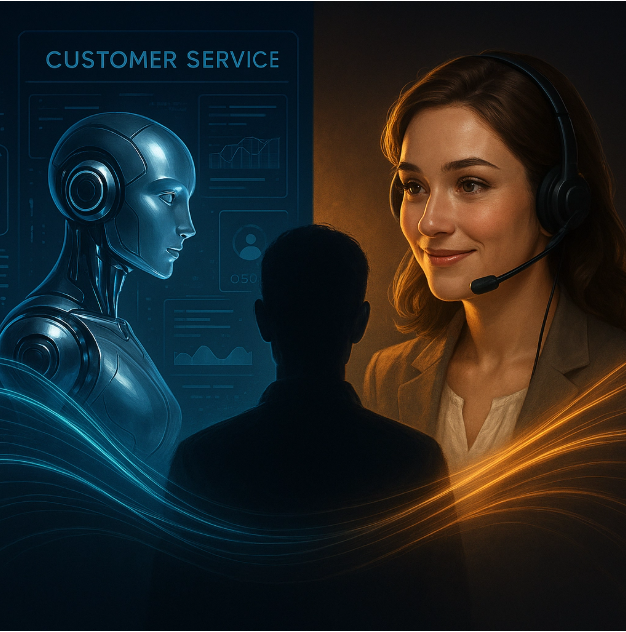
The question isn’t whether to use AI, but how to deploy it while maintaining the human elements that customers truly value. The most successful companies aren’t choosing between automation and human connection—they’re strategically blending both to create experiences that are both efficient and emotionally resonant.
Why the Human-AI Balance Matters
Getting this balance right isn’t just about customer satisfaction—it directly impacts your bottom line. Consider these compelling statistics:
- 75% of consumers prefer human interaction for complex service issues
- Companies using AI for routine tasks see up to 40% reduction in resolution times
- Organizations with balanced human-AI approaches report 35% higher customer retention rates
When automation handles what it does best and humans focus on where they add unique value, everyone wins—your customers get faster, more personalized service, and your team members engage in more meaningful work.

Where AI Shines: The Automation Advantage
AI excels at handling predictable, repetitive tasks with precision and scalability. These are prime candidates for automation:
Information Retrieval & Basic Transactions
Chatbots and virtual assistants can instantly access vast knowledge bases to answer common questions, check order status, process simple returns, or update account information. Unlike humans, they never need breaks, can handle thousands of simultaneous inquiries, and deliver consistent responses 24/7.
Data Analysis & Personalization
AI systems excel at processing customer data to identify patterns and preferences, enabling personalized recommendations and proactive service offerings. This level of customization would be impossible for human teams to deliver at scale.
Initial Contact & Routing
Intelligent systems can efficiently triage incoming customer inquiries, gather preliminary information, and direct customers to the appropriate resources—whether that’s a self-service option or a specialized human agent.
Where Humans Excel: The Irreplaceable Human Element
Despite AI’s impressive capabilities, certain aspects of customer interaction still require a human touch:
Emotional Intelligence & Empathy
When customers are frustrated, anxious, or dealing with sensitive issues, human agents can pick up on emotional cues, adapt their tone, and demonstrate genuine empathy—capabilities that even advanced AI struggles to replicate authentically.
Complex Problem-Solving
Situations requiring creative thinking, judgment calls, or deviation from standard protocols benefit tremendously from human involvement. Your team members can think laterally, consider unusual circumstances, and craft custom solutions that rigid systems simply cannot.
Relationship Building
The foundation of customer loyalty is often the personal connection built through meaningful interactions over time. Humans excel at remembering personal details, referencing past conversations naturally, and building rapport through shared experiences.
Strategies for Striking the Perfect Balance
1. Map Your Customer Journey with Intention
Begin by examining each touchpoint in your customer journey, asking:
- What is the customer’s emotional state at this stage?
- How complex or variable are the interactions here?
- What would create the most value for the customer at this moment?
This mapping helps identify where automation adds efficiency and where human interaction adds critical value. For example, automated order confirmations work well, but complex product consultations often benefit from human expertise.
2. Segment by Complexity, Not Just Volume
Rather than automating based solely on interaction frequency, consider segmenting by complexity and emotional weight:
- Low complexity/Low emotion: Ideal for full automation (order tracking, basic information requests)
- Medium complexity/Medium emotion: Perfect for hybrid approaches (AI-assisted human agents)
- High complexity/High emotion: Prioritize for direct human handling (complaint resolution, crisis management)
3. Create Seamless Handoffs Between AI and Humans
Nothing frustrates customers more than having to repeat information when transitioning from an automated system to a human agent. Design your systems to ensure context preservation during these handoffs:
- Ensure human agents receive complete conversation histories
- Implement “warm transfers” where bots introduce the human agent and summarize the situation
- Create unified customer data platforms where all interactions are logged and accessible
4. Train AI Systems to Recognize Their Limitations
Smart automation includes knowing when to escalate. Configure your AI tools to identify:
- Emotional signals indicating customer frustration
- Complex queries outside their knowledge base
- Repeated failed resolution attempts
- Explicit customer requests for human assistance
At Go Brightly AI, we help businesses configure these sophisticated escalation triggers to ensure customers never feel trapped in automation loops.
5. Humanize Your Automation
Even when interactions are automated, they needn’t feel robotic. Humanized AI communication includes:
- Conversational language rather than technical jargon
- Acknowledgment of emotions (“I understand this must be frustrating”)
- Personality elements that reflect your brand voice
- Transparency about the automated nature of the interaction
Real-World Success: Balance in Action
Case Study: Regional Healthcare Provider
A healthcare organization we worked with implemented an AI-powered appointment system that handled 80% of routine scheduling tasks. However, they specifically kept human schedulers for complex cases, including elderly patients, those with multiple health conditions requiring coordination, and first-time patients anxious about procedures.
The result? A 22% increase in appointment compliance, 35% reduction in staff administrative burden, and significantly improved satisfaction scores. Patients appreciated the efficiency of the automated system for simple tasks but valued the reassurance of human interaction when needed.
Case Study: Financial Services Firm
A mid-sized financial services company deployed chatbots for account inquiries and basic transactions while training their human advisors to focus on relationship-building and complex financial planning.
By automating routine tasks, they freed their human team to spend 40% more time on personalized consultations. Customer retention improved by 28%, and their average product adoption per customer increased by 15%—proving that strategic automation actually enhances human connection rather than replacing it.
The Future: Evolving Balance in an AI-Powered World
As we look ahead, the line between human and AI interaction will continue to blur in exciting ways:
- AI-enhanced human agents will become the norm, with real-time coaching, sentiment analysis, and recommendation engines supporting human conversations
- More sophisticated emotional intelligence in AI systems will improve their ability to recognize and respond appropriately to customer emotions
- Personalization engines will tailor not just the content of responses but the entire service approach based on individual preferences
The future isn’t about choosing between technology and humanity—it’s about using technology to amplify humanity’s best qualities.
Finding Your Perfect Balance
At Go Brightly AI, we believe the most successful customer experience strategies don’t pit technology against human connection but instead use each to strengthen the other. Our approach to AI implementation always starts with a fundamental question: “How can we use technology to make human interactions more meaningful?”
The answer differs for every business, based on your unique customers, team capabilities, and service model. The key is approaching automation not as a cost-cutting measure but as a strategic tool that enables your team to deliver more value where it matters most.
Ready to find your perfect balance between automation efficiency and human connection? Explore our consulting services or check out our customer stories to see how we’ve helped businesses just like yours navigate the exciting intersection of AI and human experience.
After all, in a world increasingly powered by algorithms, the human touch isn’t becoming less valuable—it’s becoming priceless.